
Kimi K3 Just Wiped $3.3 Trillion From Chip Stocks — And Then Immediately Ran Out of GPUs
On July 17, 2026, a Chinese AI startup released a model at midnight. By the time US markets opened that morning, investors had already made up their minds.
Sell everything.
Semiconductor stocks fell across the board. The Philadelphia Semiconductor Index — the main tracker for chipmakers worldwide — dropped more than 20% from its late-June peak, officially entering bear market territory. Taiwan's benchmark fell more than 6%. Japan closed down 4%. The Nasdaq slid 1.5%.
In total, global semiconductor stocks lost more than $3.3 trillion in market value in a matter of days.
The model was Kimi K3. The company was Moonshot AI.
And here is the twist that Wall Street missed entirely: within days of launching, Moonshot had to temporarily stop accepting new users because Kimi K3 was so popular that they ran out of GPU capacity.
A model that supposedly proved AI does not need expensive chips — immediately needed more expensive chips.
First, Understand What Actually Happened — Simply
Let us build this from the ground up, because the stock market reaction only makes sense if you understand the fear underneath it.
The basic question investors are asking:
AI companies have spent an enormous amount of money on GPU infrastructure. NVIDIA sells GPUs for tens of thousands of dollars each. Microsoft, Google, Amazon, and Meta have collectively committed to spending roughly $725 billion on AI infrastructure — data centers, chips, power, cooling — between 2025 and 2027.
The assumption behind all that spending is simple: frontier AI capability is expensive to build and expensive to run. If you want the best AI, you pay for it. That means buying from companies like OpenAI or Anthropic, who charge premium prices because building and running frontier models requires massive compute.
Now here is what frightens investors:
What if a Chinese company releases a model that is nearly as good — or in some areas better — for a fraction of the cost? What if the assumption that frontier AI requires frontier spending is wrong?
That is the question Kimi K3 reopened. And it is the same question a model called DeepSeek R1 raised in January 2025.
The DeepSeek Comparison — Why This Felt Familiar
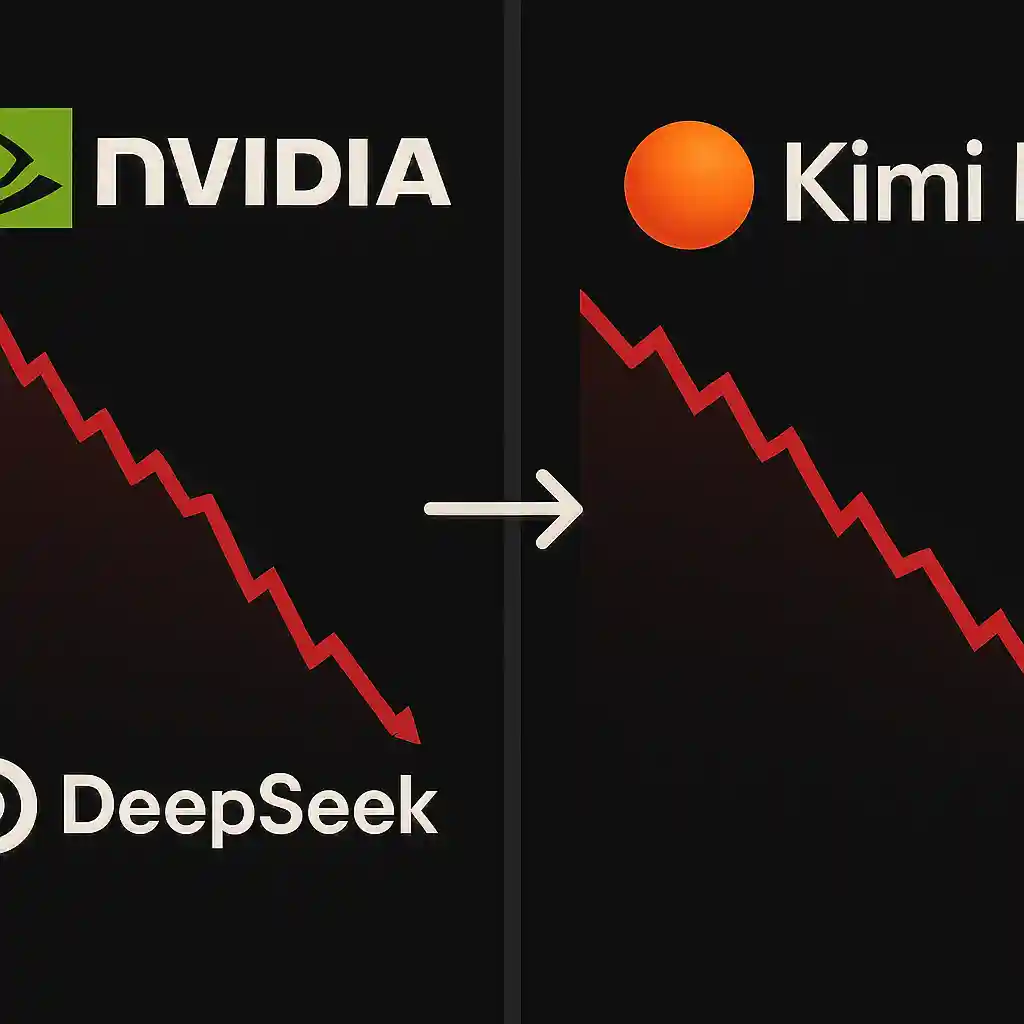
In January 2025, a Chinese AI lab called DeepSeek released a model that performed at the level of OpenAI's best offerings at the time — but was reportedly built at a dramatically lower cost.
The market reaction was immediate and brutal. NVIDIA lost approximately $590 billion in market cap in a single trading session — the largest single-day market cap loss for any company in history.
The logic investors used was: if a cheap model can match an expensive one, then the companies selling the expensive infrastructure to run expensive models are overvalued. Sell NVIDIA. Sell TSMC. Sell the data center stocks.
Now Kimi K3 arrives. Same playbook. Same fear. Same response.
Kimi K3's headline stats that scared investors:
Kimi K3 launched with 2.8 trillion parameters — the largest open-weight model ever released. On independent benchmarks, it ranked first on the Arena Frontend Code leaderboard — a 17-place climb from Moonshot's previous model — beating Claude Fable 5 specifically in coding tasks. It costs roughly half of Claude Opus 4.8 per task.
And crucially — the full model weights will be freely downloadable by July 27, 2026. Anyone can run it. Anyone can build on it.
Trump administration advisor David Sacks called the moment "concerning" and linked it to proposals to restrict data center construction and require pre-approval of new AI models. "This is how you lose the AI race," he wrote on X.
Why Chip Stocks Fall When a Cheap AI Model Launches
Here is the exact logic that runs through investor minds when something like Kimi K3 drops — explained as simply as possible.
Step 1 — Cheap model arrives
A Chinese lab releases a powerful model at a low price. The model is open-weight, meaning anyone can download and run it for free.
Step 2 — Investors ask: who loses?
If companies can get near-frontier AI performance cheaply, they will not pay premium prices to OpenAI or Anthropic. If those companies earn less revenue, they buy fewer GPUs. If they buy fewer GPUs, NVIDIA sells less. If NVIDIA sells less, its revenue projections look wrong. If its revenue projections look wrong, its stock price is too high.
Step 3 — Sell first, ask questions later
This chain of logic runs in milliseconds across trading algorithms. The result is a broad selloff across every company whose valuation depends on AI spending staying high.
Step 4 — The global spillover
TSMC makes the chips that power AI models — for NVIDIA, Apple, AMD, and others. If AI chip demand is going to fall, TSMC's order books look less full. Taiwan's market sells off. South Korea's chipmakers follow. Japan's tech stocks follow. The entire global semiconductor supply chain prices in the fear simultaneously.
This is what $3.3 trillion of market cap disappearing in three days looks like.
The Problem With This Logic — What Wall Street Missed
Here is the part that Wall Street priced in last, if at all.
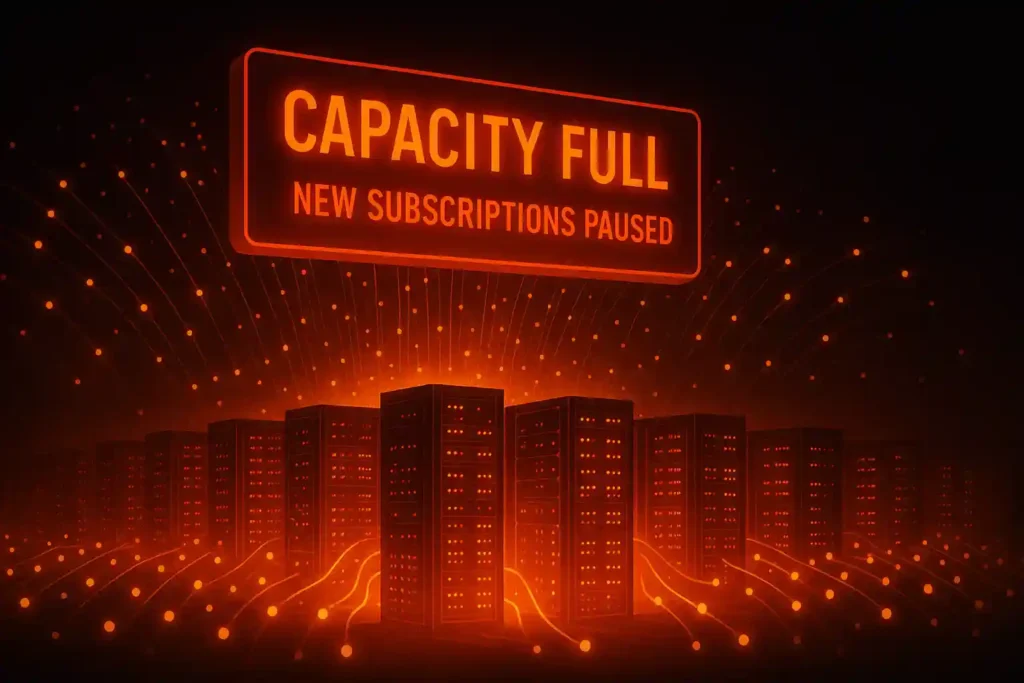
Three days after Kimi K3 launched, Moonshot AI sent a notice to its users. The model had been so popular that new subscriptions were temporarily paused. User traffic had pushed the company's GPU capacity to its limits. Moonshot needed to add more computing resources before it could accept new customers.
Read that again slowly.
A model that investors feared would reduce demand for AI chips — immediately created so much demand that the company ran out of AI chips.
This is not a coincidence. It is a pattern. Fireworks AI crossed $1 billion in revenue running open-weight models for enterprise customers. The cheaper models got, the more companies started using AI at scale. Total compute demand went up, not down. The same thing happened after DeepSeek — NVIDIA's actual order books did not shrink. Infrastructure spending targets were not cut. The panic sold the wrong layer.
InvestorPlace senior analyst Luke Lango put it plainly: "Wall Street found a real disruption. It just sold the wrong layer. K3 may pressure model pricing, but every token it generates still needs chips, memory, networking, data centers, and power."
This is how the open-weight model economy actually works. Lower cost per token does not reduce chip demand — it expands the number of use cases where AI becomes economically viable, which increases total token volume, which increases total chip demand. Linus Torvalds captured this dynamic when he declared Linux not an anti-AI project — open availability of powerful tools does not shrink markets, it grows them.
What the Numbers Actually Show
Despite the selloff, the actual business fundamentals of chip companies did not change.
Taiwan Semiconductor Manufacturing Company — the company that physically manufactures chips for NVIDIA, Apple, AMD, and almost everyone else — reported earnings the same week. TSMC beat earnings estimates and raised its 2026 guidance. Its order books were fuller than analysts expected, not emptier.
The selloff hit TSMC's stock anyway, because markets price fear, not just facts.
NVIDIA was down. AMD was down. Intel was down. Memory chip makers in South Korea were down. None of them had changed their actual revenue guidance. None of them had reported reduced orders. The entire move was investors pricing in a risk that had not yet materialized — and that the Moonshot capacity pause suggests may not materialize in the way investors feared.
The Part That Should Worry Enterprises — The 51% Hallucination Rate
While Wall Street was busy panicking about chips, a quieter but more practically important number emerged from independent testing of Kimi K3.
Independent evaluators found a 51% hallucination rate for Kimi K3 — meaning that in approximately half of tested cases where the model provided factual information, it generated content that was inaccurate, invented, or misleading.
For benchmark performance on coding tasks, Kimi K3 is genuinely impressive — competitive with or better than frontier models in specific areas. But for enterprise use cases that require reliable factual output — legal analysis, financial reporting, medical documentation, customer-facing responses — a 51% hallucination rate is not a minor footnote. It is a disqualifying characteristic for most production deployments.
This matters because the market panic around Kimi K3 implicitly assumed it was a drop-in replacement for frontier proprietary models. It is not — not yet. Claude Sonnet 5 and Claude Fable 5 maintain lower hallucination rates and stronger factual reliability, which is a significant part of why enterprises pay premium prices for them rather than using free open-weight alternatives.
The pricing pressure from Kimi K3 on frontier model providers is real. The capability gap that justifies premium pricing has not yet closed.
Moonshot's Next Move — Hong Kong IPO
The market reaction to Kimi K3 did not slow Moonshot's ambitions. It may have accelerated them.
On July 20, 2026 — three days after the global chip selloff began — Moonshot AI circulated a shareholder resolution seeking approval for a Hong Kong initial public offering within six months, targeting a valuation of approximately $30 billion.
To put that in perspective: Moonshot was valued at $2.5 billion in 2024 when Alibaba injected $1 billion into the company. Today, the company is targeting a valuation twelve times that — on the back of a model that just wiped $3.3 trillion from global chip stocks and simultaneously ran out of GPU capacity trying to serve the people who wanted to use it.
The IPO timing is significant. A Hong Kong listing gives Moonshot access to international capital markets while keeping primary listing outside the reach of US regulatory restrictions on Chinese AI companies. It also gives Moonshot the public market currency it would need to fund the GPU expansion required to actually serve the demand Kimi K3 created.
The GitHub Copilot decision to add Kimi K2.7 Code as its first open-weight model — just two weeks before the K3 launch — now looks like a piece of a broader pattern. Moonshot is not just releasing models. It is building an ecosystem, a commercial platform, and now a public market story.
What This Means For The AI Industry Going Forward
The Kimi K3 moment is best understood not as a repeat of DeepSeek but as a confirmation that the AI industry has entered a new phase — one where frontier capability is no longer exclusively American and exclusively proprietary.
Six months ago, the frontier AI landscape had three players: Anthropic, OpenAI, and Google. Today it has at least five — with Moonshot AI and DeepSeek both placing models in the top tier of independent benchmarks. Kimi K3 sits fourth overall on independent aggregate leaderboards, behind Claude Fable 5 and GPT-5.6 Sol but ahead of Claude Opus 4.8.
That compression of the capability gap changes the economics of AI in ways that are still playing out.
For enterprises building AI products, the choice of model provider now involves real trade-offs between cost, performance, reliability, and geopolitical risk — rather than simply picking the most capable option available. As we covered in our analysis of what AI already knows about you from your online activity, where your data goes when you use an AI model matters — and routing sensitive business data through a Chinese-origin model, even one hosted on Azure, carries policy and compliance implications that do not exist with US-based providers.
For chip companies, the Kimi K3 reaction is a reminder that market panic and business fundamentals are not the same thing. The semiconductor bear market triggered by a single model release — and immediately contradicted by that model's own GPU shortage — tells you more about how investors react to AI news than about the actual trajectory of AI infrastructure demand.
For the US-China AI competition, Kimi K3 is a signal that Chinese labs are closing the capability gap faster than most Western observers expected. David Sacks's alarm is understandable even if the specific regulatory proposals he linked to it are debatable.
Frequently Asked Questions
What is the Kimi K3 chip stock crash?
When Moonshot AI released Kimi K3 on July 17, 2026, global semiconductor stocks fell sharply as investors feared that a powerful low-cost open-weight AI model from China would reduce demand for expensive AI chips. The Philadelphia Semiconductor Index fell more than 20% from its late-June peak — entering bear market territory — and global chip stocks lost more than $3.3 trillion in market value over several days.
Why did Kimi K3 cause chip stocks to fall?
Investors feared that if a cheap open-weight AI model could match expensive proprietary frontier models in performance, companies would spend less on AI infrastructure — meaning fewer GPU orders for NVIDIA and other chipmakers. This same logic drove the DeepSeek selloff in January 2025.
Did Kimi K3 actually reduce demand for chips?
The opposite happened. Demand for Kimi K3 was so high that Moonshot AI had to temporarily pause new subscriptions because it ran out of GPU capacity. This directly contradicts the market's fear that cheaper AI models reduce chip demand — cheaper models expand usage, which increases total compute demand.
How much did chip stocks fall because of Kimi K3?
Global semiconductor stocks lost more than $3.3 trillion in market value in the days following Kimi K3's launch. The Philadelphia Semiconductor Index fell more than 20% from its late-June peak. Taiwan's benchmark fell more than 6%. The Nasdaq slid 1.5% on the worst day of the week.
Is Kimi K3 actually better than Claude and GPT?
Kimi K3 leads on specific coding benchmarks — including the Arena Frontend Code leaderboard where it ranked first, beating Claude Fable 5. On overall aggregate benchmarks, it ranks fourth — behind Claude Fable 5 and GPT-5.6 Sol. Independent testing also found a 51% hallucination rate, which limits its reliability for enterprise use cases that require factual accuracy.
What is the DeepSeek comparison for Kimi K3?
DeepSeek R1, released in January 2025, was a Chinese AI model that performed competitively with US frontier models at lower cost — triggering a massive chip stock selloff including a single-day $590 billion market cap loss for NVIDIA. Investors drew the same comparison with Kimi K3, treating it as a second "DeepSeek moment" with a similar market reaction.
What is Moonshot AI's IPO plan?
Following the Kimi K3 launch, Moonshot AI circulated a shareholder resolution seeking approval for a Hong Kong initial public offering within six months, targeting a valuation of approximately $30 billion — up from a $2.5 billion valuation when Alibaba invested in the company in 2024.
Should enterprises use Kimi K3?
It depends on the use case. For coding tasks where hallucination risk is lower and performance is measurable, Kimi K3 is worth evaluating. For use cases requiring factual reliability — legal, financial, medical, or customer-facing — the 51% hallucination rate is a significant concern. Enterprise teams should also review the data governance implications of routing sensitive business information through a model from a Chinese company, even one hosted on US infrastructure.

Sia is the co-founder of Corenexis and one of the earliest voices shaping its editorial direction. With years of hands-on experience covering AI and technology, she has been writing about the digital world long before it became everyone's favorite topic — and she still does it better than most.
View all posts by Sia →
0 Comments
Community guidelines
We want the comments to be useful for every reader. Every comment is reviewed before it is published. A comment will not be approved if it is:
Keep it genuine and on-topic and it will be approved quickly. Thank you for helping keep the discussion clean.