
GitHub Copilot Just Added Its First Open-Weight Model — And It Is from China
For five years, every model in GitHub Copilot's model picker came from the same small circle of American AI companies. OpenAI built Copilot. Anthropic added Claude. Google added Gemini. Microsoft added its own models.
On July 1, 2026, that changed.
GitHub added Kimi K2.7 Code — a trillion-parameter coding model from Beijing-based Moonshot AI — to the Copilot model picker. It is the first open-weight model ever offered in Copilot. The full model weights are publicly available, MIT-licensed, and downloadable by anyone. Copilot users can now select a model that no proprietary AI lab controls.
For the 4.7 million developers paying for Copilot subscriptions, a new option appeared in a dropdown. For the broader AI industry, something more significant happened: the line between closed enterprise AI tools and open-weight models just got permanently blurrier.
What Is Kimi K2.7 Code?
Kimi K2.7 Code is a coding-optimized model from Moonshot AI — the same Beijing-based company behind the Kimi K3 frontier model. It is built on a Mixture-of-Experts architecture with one trillion total parameters, with only a fraction of those parameters active during any single inference — the same design principle that makes large models practical to run at scale without proportionally large compute costs.
The model was published on Hugging Face on June 12, 2026 — and reached general availability in GitHub Copilot just 19 days later. That is one of the fastest transitions from open-weight release to enterprise platform deployment on record.
Kimi K2.7 Code is specifically optimized for coding tasks — code generation, debugging, code review, and multi-file editing. GitHub's own documentation describes it as providing "strong performance comparable to highly popular frontier models" at a lower cost point. No detailed public benchmark table was published at launch, but early developer testing suggests it is competitive with Claude Sonnet and GPT-4o on standard coding benchmarks.
If you have been using Kimi K2 through OpenRouter or exploring Kimi K2 as a standalone deployment, K2.7 Code is a refined, coding-specific successor to that model — now available inside the tool most developers already have open all day.
How to Access Kimi K2.7 Code in GitHub Copilot
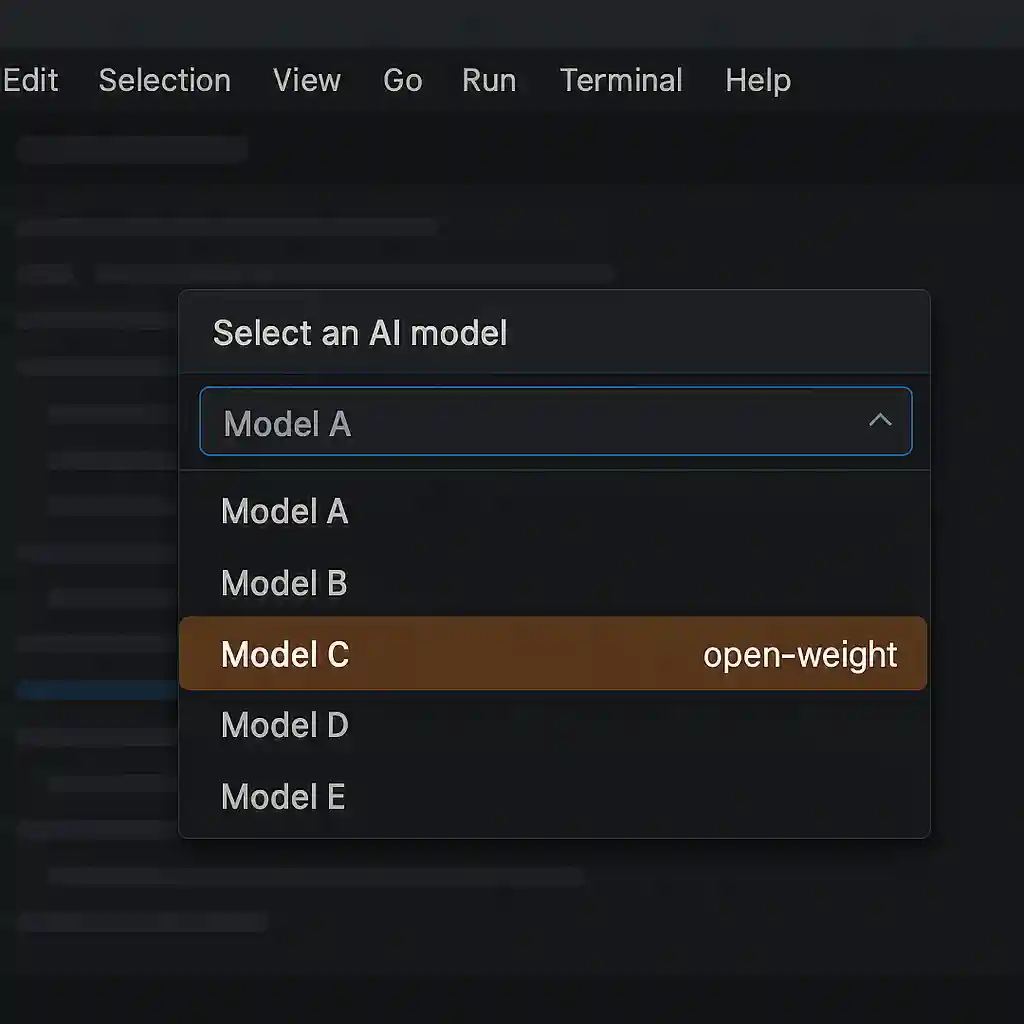
Accessing the model is straightforward for individual plan users. The rollout is gradual, so not every account sees it immediately — but once it reaches your plan, the process is simple.
Step 1 — Update your editor
Kimi K2.7 Code requires up-to-date versions of supported editors. For VS Code, you need version 1.127.0 or later. For Visual Studio, version 17.14.6 or later. For JetBrains IDEs, version 1.9.1-251 or later. Xcode, Eclipse, and Copilot CLI are also supported. GitHub.com and GitHub Mobile (iOS and Android) work through the web and app interfaces without requiring an update.
Step 2 — Open the model picker
In VS Code with GitHub Copilot active, look for the model picker in the Copilot Chat panel. Click the model name currently displayed — this opens a dropdown of all available models.
Step 3 — Select Kimi K2.7 Code
Scroll through the list and select Kimi K2.7 Code. The switch takes effect immediately for your next prompt.
Step 4 — Check billing
Kimi K2.7 Code is billed through GitHub's AI Credit system, introduced on June 1, 2026, where one credit equals $0.01. It is billed at provider list pricing — placing it in a lower cost tier than the frontier proprietary models currently in Copilot. No new subscription tier is required.
For Business and Enterprise admins
Kimi K2.7 Code is off by default for Copilot Business and Enterprise plans. Administrators must explicitly enable it in Copilot organization settings before any user in the organization can select it. GitHub recommends reviewing the model against your organization's security and compliance requirements before enabling.
Copilot Now Has Five Labs — What That Means
Before July 1, 2026, GitHub Copilot's model picker drew from four AI labs: OpenAI, Anthropic, Google, and Microsoft. Every model was proprietary — built by companies whose revenue depends on keeping model weights private.
Kimi K2.7 Code completes a five-lab roster and breaks the proprietary-only pattern simultaneously.
| Lab | Model in Copilot | Type |
|---|---|---|
| OpenAI | GPT-4o, o3 | Proprietary |
| Anthropic | Claude Sonnet 5 | Proprietary |
| Gemini models | Proprietary | |
| Microsoft | Phi models | Proprietary |
| Moonshot AI | Kimi K2.7 Code | Open-weight |
Claude Sonnet 5, which Anthropic positioned as near-Opus performance at lower cost, now sits in the same picker as an open-weight model that costs even less. The competitive pressure on pricing across all Copilot models is now visible in a single dropdown.
The same week Kimi K2.7 Code launched in Copilot, GitHub retired Gemini 2.5 Pro and Gemini 3 Flash from the picker. Model lineup churn in Copilot is accelerating — what is in the picker today may not be there in three months.
The Chinese AI Question — What Enterprises Need to Know

This is the part of the story that enterprise security and compliance teams need to pay attention to.
Kimi K2.7 Code is built by Moonshot AI — a Chinese company subject to China's National Intelligence Law. That law can require Chinese companies to cooperate with state intelligence agencies upon request, including potentially providing access to data processed by their systems.
GitHub's response to this concern is hosting. Kimi K2.7 Code runs on Microsoft Azure's US-based infrastructure. Your prompts route to Azure — they do not go to Moonshot's own servers in China. GitHub explicitly states this in its documentation.
But Azure hosting solves one problem while leaving others open. It changes where data flows at inference time. It does not change what Beijing can legally ask of Moonshot about the model's development pipeline, training data, future updates, or the underlying architecture. The weights are public and auditable — that is actually a transparency advantage over proprietary models. But the company that created those weights operates under Chinese law.
This is not hypothetical. US lawmakers opened a formal inquiry into PRC-origin AI models in April 2026 — specifically including Kimi models used in developer tools like Cursor's Composer product. The Institute for AI Policy and Strategy recommended in a February 2026 memo that the government consider restricting Kimi-based products from federal devices.
Enterprise security firm Harmonic Security found that, as of early 2026, Kimi Moonshot was already generating roughly 3.5 times more shadow AI traffic in enterprise environments than DeepSeek — with code, financial documents, and internal communications being the most common content types sent to the model outside of official IT channels.
GitHub's own documentation acknowledges the concern directly: it warns that Kimi K2.7 Code "may be less aligned than other Copilot models" and recommends administrators review it against their security and compliance requirements before enabling for their organization.
For teams handling sensitive code, financial data, healthcare information, or government contracts, this is not a model to enable without a deliberate policy review. For teams doing general software development without data sensitivity constraints, the cost advantage and coding performance may well justify the tradeoff.
Why This Matters Beyond One Model Addition
The addition of Kimi K2.7 Code to Copilot is a data point in a larger shift that has been building throughout 2026.
Linus Torvalds declared in July 2026 that Linux is not an anti-AI project and told critics to "fork it or walk away." His position is that AI tools should be judged by their technical output — not by ideology about who built them or where. The GitHub Copilot model picker is now implementing exactly that philosophy at enterprise scale: users choose based on performance and cost, not on which lab built the model.
Fireworks AI's crossing of $1 billion in revenue running open-weight models for enterprise customers showed that the infrastructure for open-weight deployment at scale already exists. GitHub adding an open-weight model to Copilot brings that same shift to the developer tool layer — making open-weight models not just a self-hosting option for technical teams but a default option for any developer with a Copilot subscription.
The Hugging Face AI cyberattack disclosed just two weeks after the Kimi K2.7 launch also adds a security dimension to the open-weight story. Hugging Face's security team found that frontier model safety guardrails blocked legitimate defensive security work — and had to use an open-weight model locally to analyze the attack. Open-weight models running without API restrictions turned out to be essential tools in a live incident. Kimi K2.7 Code's weights were published on Hugging Face on June 12 — the same platform that was breached on July 16.
Kimi K2.7 Code vs Other Copilot Models — How to Choose
With five labs now in the Copilot picker, the practical question is when to use which model.
For general coding tasks — Kimi K2.7 Code or Claude Sonnet 5
Both are positioned as capable, cost-effective options for everyday coding. Kimi K2.7 Code is cheaper. Claude Sonnet 5 has stronger safety alignment and more predictable behavior on edge cases. If cost is the priority and the code is not sensitive, Kimi is worth testing. If consistency and alignment matter more, Sonnet 5 is the safer default.
For complex reasoning and architecture work — GPT-4o or Claude Sonnet 5
Kimi K2.7 Code's benchmark advantage is on coding-specific tasks. For broader reasoning, system design, and architectural analysis, the frontier proprietary models still have the edge.
For maximum context — Kimi K3
If you need a one-million-token context window for large codebases, the full Kimi K3 model via API gives you that — but it is not in Copilot's picker yet. K2.7 Code's context window is 256k tokens, which handles most real-world codebases comfortably.
For AI coding hardware — OpenAI recently launched the Codex Micro keyboard, a physical device built around Codex coding workflows. It integrates with OpenAI's models, not Kimi — a reminder that the hardware layer of AI coding tools is still primarily US-controlled even as the model layer globalizes.
What Happens Next
GitHub has signaled that Copilot's model picker will continue to expand. The five-lab roster as of July 2026 is almost certainly not the final state.
The more consequential question is whether other open-weight models follow Kimi K2.7 into Copilot. If GitHub is willing to host and distribute a Chinese open-weight model through Azure, it is presumably also willing to host open-weight models from European or American labs. Meta's Llama models, Mistral's models, and eventually Kimi K3's open weights — scheduled for release by July 27, 2026 — are all candidates.
The model picker is becoming less like a preference menu and more like a procurement surface. For developers, that means more choice. For enterprises, that means more policy decisions. For the AI labs whose models are in the picker, it means competing on cost and performance against models whose weights anyone can download and audit.
That competitive pressure benefits developers. It complicates the business model for every proprietary AI lab at the same time.
Frequently Asked Questions
What is the first open-weight model in GitHub Copilot?
Kimi K2.7 Code from Moonshot AI became the first open-weight model available in GitHub Copilot's model picker on July 1, 2026. Unlike all previous Copilot models, Kimi K2.7 Code's weights are publicly available under an MIT license and can be downloaded, audited, and self-hosted by anyone.
How do I use Kimi K2.7 Code in GitHub Copilot?
Update your editor to the required minimum version — VS Code 1.127.0, Visual Studio 17.14.6, or JetBrains 1.9.1-251. Then open the model picker in the Copilot Chat panel and select Kimi K2.7 Code. It is available on Copilot Pro, Pro+, and Max plans. Business and Enterprise plans require administrator enablement.
Is Kimi K2.7 Code safe to use in enterprise environments?
GitHub routes prompts through Microsoft Azure rather than Moonshot's own servers, which addresses the most direct data routing concern. However, Moonshot AI is a Chinese company subject to Chinese law, and GitHub's documentation warns the model "may be less aligned than other Copilot models." Enterprise teams handling sensitive code or regulated data should review the model against their security and compliance requirements before enabling it.
How much does Kimi K2.7 Code cost in GitHub Copilot?
Kimi K2.7 Code is billed through GitHub's AI Credit system at provider list pricing — placing it in a lower cost tier than the frontier proprietary models like GPT-4o and Claude Sonnet 5 in Copilot's current roster. One AI Credit equals $0.01.
What is the difference between Kimi K2.7 Code and Kimi K3?
Kimi K2.7 Code is a coding-optimized model with a 256k token context window, available in GitHub Copilot. Kimi K3 is Moonshot's flagship frontier model with 2.8 trillion parameters and a one-million-token context window. K3 is available via API but not yet in Copilot's model picker. Full K3 open weights are scheduled for public release by July 27, 2026.
Why did GitHub add a Chinese AI model to Copilot?
GitHub's stated reason is giving developers more choice and a lower-cost option. Kimi K2.7 Code's performance on coding benchmarks is competitive with more expensive proprietary models. Azure hosting keeps data within US infrastructure rather than routing to Moonshot's servers.
Did GitHub remove any models when Kimi K2.7 Code was added?
Yes. The same week Kimi K2.7 Code launched, GitHub retired Gemini 2.5 Pro and Gemini 3 Flash from the Copilot model picker. Model lineup churn in Copilot is active — the roster changes frequently as GitHub evaluates model quality and performance.
What plans support Kimi K2.7 Code in GitHub Copilot?
Kimi K2.7 Code is available on Copilot Pro, Pro+, and Max plans and is enabled by default for individual users. For Copilot Business and Enterprise plans, the model is off by default and requires explicit administrator enablement in Copilot organization settings.

Sia is the co-founder of Corenexis and one of the earliest voices shaping its editorial direction. With years of hands-on experience covering AI and technology, she has been writing about the digital world long before it became everyone's favorite topic — and she still does it better than most.
View all posts by Sia →

0 Comments
Community guidelines
We want the comments to be useful for every reader. Every comment is reviewed before it is published. A comment will not be approved if it is:
Keep it genuine and on-topic and it will be approved quickly. Thank you for helping keep the discussion clean.