
Flock Safety AI Errors: What Happens When the Algorithm Gets It Wrong
A journalist was tracked by police for days. Officers surrounded his car with guns drawn. The reason? A Flock Safety AI camera had misread a license plate.
He was innocent. The system was wrong. And according to Flock Safety's own numbers, this kind of error happens roughly 200 million times every month across the United States.
Flock Safety is one of the most widely deployed AI surveillance companies in America. Its automated license plate reader cameras sit on poles across more than 5,000 cities and towns, quietly scanning every vehicle that passes. When the system flags a plate as stolen or wanted, an alert goes to police in real time. Officers respond. And if the AI was wrong — as it is one percent of the time — the person behind the wheel pays the price.
This is exactly the kind of invisible data collection we covered in our piece on what AI already knows about you from your online activity — except here, the consequences are not digital. They are physical.
This is the story of what those errors look like in practice, who is being hurt, and why the backlash against Flock Safety is now reaching the halls of Congress.
What Is Flock Safety?
Flock Safety is an Atlanta-based company that sells AI-powered automated license plate reader cameras — known as ALPRs — to police departments, homeowners associations, and municipalities across the United States. Founded in 2017, the company has grown to deploy more than 80,000 cameras nationwide and is currently valued at $7.5 billion.
The system works by capturing the license plate number, vehicle make, model, and color of every vehicle that passes a camera. That data feeds into a searchable database that law enforcement agencies can query in real time. When a plate matches one flagged as stolen or associated with a wanted person, the system sends an alert to officers immediately.
The pitch is straightforward: faster crime solving, lower cost than traditional patrol, and community-wide coverage that no number of officers could replicate on foot. Flock claims its system helps solve 10 percent of reported crime in the areas where it is deployed. Major cities including Los Angeles, San Francisco, and hundreds of smaller municipalities signed contracts.
The problem is what happens when the AI is wrong — and the documented evidence shows it is wrong far more often than most users of the system understood when they signed up. Unlike Meta's Instagram AI opt-out controversy where users at least had the option to say no, drivers on public roads have no choice at all. Every car that passes a Flock camera is scanned — whether you know about it or not.
The 1% Error Rate — What It Actually Means
Flock Safety has publicly acknowledged that its system has a roughly one percent error rate on license plate reads.
One percent sounds small. At scale, it is not.
Flock's cameras collectively process approximately 20 billion license plate reads per month across the United States. A one percent error rate on that volume translates to 200 million misreads every single month.
Joel Feder, the journalist at The Drive who was tracked and ambushed by police in June 2026, put it plainly after Flock responded to his account: "That 1% error rate, of which I was a part of in June, makes for two hundred million misreads a month. How many lead to aggressive stops that put civilians and officers in a dangerous situation?"
The answer, based on documented cases, is far more than has been publicly reported. This is not the first time AI confidence in wrong outputs has caused real-world harm. When Mitch McConnell's hospital photo was incorrectly flagged as AI-generated by online tools, the consequences were reputational. When Flock flags the wrong license plate, the consequences can be a gun pointed at your face.
Roseville, California: 71% of Alerts Were Wrong
In August 2026 the argument stopped being theoretical.
Business Insider, working from Roseville Police Department records, analysed 1,427 Flock alerts sent to the department across 2023 and 2024 — alerts flagging vehicles as stolen or connected to felonies. In 71% of them the licence plate had been misread.
Not 1%. Seventy-one.
Set that against what the company advertises. Flock states that under recommended deployment it measures “>99% capture rate in clear weather and rain, >96% OCR accuracy and >97% plate-state accuracy”. Roseville is a mid-sized Californian city running the product as sold to it. The gap between 96% claimed and 29% observed is not a rounding difference — it is the difference between a tool that works and one that does not.
What Flock said, and what Roseville said back
Flock attributed the results to how Roseville had installed the system, citing “older hardware and non-standard installation locations that resulted in the cameras being placed further from the vehicles and higher than we’d typically recommend”. The city had also chosen rear-only plate capture, specifically to avoid recording faces.
That explanation deserves to be reported fairly, and it also deserves scrutiny. Roseville police disputed Flock’s assertion that performance had significantly improved. And there is a structural problem with the defence: if accuracy collapses when cameras are mounted slightly higher, further back, or on older hardware, then the advertised figures describe a laboratory rather than a street. Every deployment is someone’s “atypical” deployment.
The detail that should worry anyone evaluating this technology came a year earlier. In April 2025, a Roseville police supervisor told Flock that 16 of the 17 plates flagged in the preceding week were wrong — including misreads where the cameras confused characters that do not visually resemble each other at all.
The part that prevented harm
One fact deserves equal prominence, because it is the reason Roseville is a story about accuracy rather than a story about injuries: none of the false alerts led to a traffic stop or an arrest.
Roseville requires officers to independently confirm a vehicle is stolen, or to have separate reasonable suspicion, before acting on a Flock hit. That policy absorbed a 71% error rate without producing a single wrongful stop in the reviewed period.
That is the whole argument in one data point. The technology failed constantly; the procedure around it held. Where that procedure is absent — as in the cases documented below — the same error rate puts people on the ground at gunpoint.
How many people this has actually affected
The Institute for Justice has documented at least 27 cases of wrongful stops, detentions or arrests traced to Flock misreads. Among them: a San Diego man jailed for nearly a month after a Flock alert falsely linked his vehicle to a violent crime.
Twenty-seven documented cases is a floor, not a ceiling. It counts the incidents that surfaced through litigation or reporting. A false alert that ends in a tense roadside conversation and no paperwork leaves no record to count.
The Journalist Who Got Ambushed
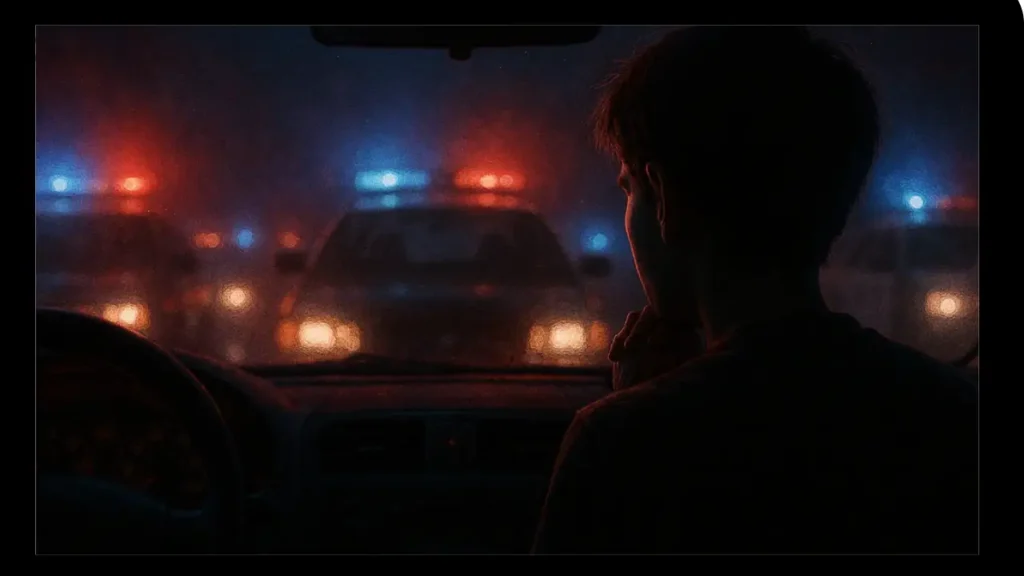
Joel Feder, a journalist for The Drive, found himself being tracked by police for multiple days following an error in the Flock system. He was flagged — incorrectly — as a person of interest. Because Flock's network allows alerts to be shared across jurisdictions, multiple police agencies became involved.
When officers finally moved on the alert, they did not knock on a door or make a traffic stop. They conducted what Feder describes as a coordinated takedown — surrounding his vehicle with guns drawn.
He had done nothing. No crime had been committed. The AI had misread a plate, the alert had propagated across the network, and the response had escalated to armed confrontation.
Flock Safety responded to the story by saying its cameras had worked "correctly" — meaning the cameras captured the plate accurately and the system processed the alert as designed. Their position was that the error came from how law enforcement entered and verified the target plate information, not from the AI itself.
That distinction matters to Flock. It does not matter much to someone who has just had guns pointed at them for something they did not do. The incident drew direct comparisons to how Claude Fable 5 was suspended by the US government over AI safety concerns — in both cases, the question was not whether the AI worked as designed, but whether the design itself created unacceptable risk.
Documented Cases of Flock AI Errors
Feder's case is not an isolated incident. A Business Insider investigation from March 2026 documented more than a dozen similar cases, and additional reporting has expanded that number significantly.
Sherwood, Arkansas — February 2026
A family with young children was pulled over in a full felony stop with guns drawn. Their black Chevrolet Tahoe had been flagged because a damaged license plate frame caused the AI to misread one character — interpreting an X as a Y. The plate matched a stolen vehicle entry. The family's vehicle was not stolen. Officers did not verify the mismatch before initiating the stop.
Los Angeles — ongoing
An internal LAPD audit found that 161 people had been tracked by Flock cameras after their vehicles were incorrectly flagged as stolen. Despite this finding, the LAPD's stated reason for not renewing its Flock contract in July 2026 was a data ownership dispute rather than the error rate itself.
San Francisco — June 2026
San Francisco Police Chief Derrick Lew disclosed on June 1, 2026, that an internal audit had found 299 improper searches of the city's Flock ALPR data. These searches were conducted on behalf of federal and out-of-state law enforcement agencies without proper authorization.
Milwaukee — February 2026
Milwaukee Police Officer Josue Ayala was criminally charged after using the Flock system to stalk a romantic partner. He ran her license plate 124 times and her former partner's plate 55 times over a two-month period. The Flock system's audit logs recorded every query — which is how the pattern was discovered — but the access itself was not flagged as unusual in real time.
LAPD Drops Flock — But Not for the Reasons You Might Expect
The Los Angeles Police Department's decision not to renew its Flock Safety contract in July 2026 generated significant coverage, but the stated reason was not the AI error rate or the wrongful stops.
The LAPD said it was ending the contract because Flock had not provided sufficient clarity on who owned the data collected by the 138 cameras deployed across the city. Specifically, the department wanted written assurances about how data would be retained, who could access it, and whether it could be shared with federal agencies including immigration enforcement.
Flock had previously cut off access for ICE following public pressure, but the LAPD wanted contractual guarantees rather than policy commitments that could be changed. Flock did not provide them. The contract was not renewed.
The 161 wrongful flags documented in the audit did not appear in the LAPD's official explanation for the decision. That absence itself tells a story about how these errors are being treated institutionally — as acceptable background noise rather than a systemic problem requiring correction. This data ownership concern mirrors exactly what we covered when Instagram users discovered Meta was using their photos for AI training without clear disclosure — in both cases, users and institutions only pushed back when they found out what was already happening.
Security Vulnerabilities on Top of AI Errors
The AI error problem is compounded by a separate and serious security problem in the cameras themselves.
In January 2026, a cloud misconfiguration at Flock exposed live video feeds from its Condor pan-tilt-zoom cameras. Footage was publicly accessible on the open internet without any authentication requirement. The exposed feeds included high-resolution footage of public spaces and private properties — including footage of children. There was no evidence that the exposure was the result of an attack — it was caused by misconfigured access controls on Flock's cloud infrastructure.
Security research firm GainSec published a report documenting more than 50 critical vulnerabilities in Flock's ALPR camera systems. The findings included hardcoded passwords, lack of encryption, and unauthorized data collection. Flock disputed the severity of the findings, claiming the vulnerabilities required physical access and specialized knowledge to exploit.
Researchers challenged that claim. Testing conducted on cloud-connected devices produced identical results without physical access. 404 Media independently verified more than 60 exposed production cameras that were publicly accessible.
These security failures fit a pattern that goes beyond Flock. As we detailed in our piece on what AI already knows about you from your online activity, the infrastructure collecting data about ordinary people is frequently less secure than the companies behind it acknowledge — and the exposure often only becomes public because of independent researchers, not internal disclosure.
Congress Takes Notice
The cumulative weight of the AI errors, the security vulnerabilities, and the documented cases of misuse prompted a formal legislative response in early 2026.
In February 2026, US Senators Ron Wyden of Oregon and Raja Krishnamoorthi of Illinois sent a formal letter to the Federal Trade Commission requesting an investigation into Flock Safety's practices. The letter cited concerns about data security, the risk of misuse by law enforcement, and the absence of adequate safeguards against the kinds of wrongful stops that had been publicly documented.
The FTC investigation request is still pending as of July 2026. No formal enforcement action has been announced.
The broader policy conversation about AI surveillance tools and their accountability is also moving — slowly — at the state level. Several states are considering legislation that would require public disclosure of ALPR deployments, mandatory audit logs of all queries, and minimum accuracy standards before a system can be used to initiate a law enforcement contact.
How Flock Safety Responds to Criticism
Flock Safety's public position on its error rate has been consistent: the cameras capture data correctly, and errors occur when human operators input incorrect plate information or fail to verify alerts before acting.
The company argues that its system includes instructions requiring officers to always manually verify an alert before initiating a stop. It points to confidence level settings that allow departments to calibrate how aggressively the system flags plates. And it notes that any ALPR system is a tool that depends on how it is used.
There is something to this argument. The Milwaukee stalking case was a human misuse of the system, not an AI error. Some of the wrongful stops involved officer decisions to escalate without verification.
But critics argue that Flock's design choices make these outcomes predictable rather than incidental. Constant real-time alerts create pressure to respond quickly. Confidence thresholds are often set by administrators who prioritize catch rates over accuracy. Nationwide data sharing means a flag entered incorrectly in one jurisdiction can trigger a response in another where no one has context on the original entry. And at 200 million misreads per month, the probability that any given alert is wrong is not trivial.
The system, in other words, is working as designed. That is part of the problem.
What This Means for AI Surveillance More Broadly
The Flock Safety story is not only about one company's cameras. It is about what happens when AI-powered surveillance tools are deployed at scale without adequate accountability infrastructure.
The open source AI community is grappling with similar questions from a different direction. When Linus Torvalds declared that Linux is not an anti-AI project and told critics to "fork it or walk away," he was arguing that AI tools should be judged by their output quality. The Flock Safety case raises the follow-up question: who judges the output when the output is a police alert that sends armed officers to surround an innocent person?
The infrastructure behind AI deployment also matters here. Companies like Fireworks AI, which recently crossed $1 billion in revenue running open source models at scale, represent the argument that AI infrastructure should be more transparent and controllable. Flock's closed, proprietary system — where camera software, alert logic, and data access policies are all controlled by a single private company — represents the opposite model. The accountability gaps in that model are now documented in court filings, police audits, and Senate letters.
There is also a direct connection to how frontier AI models handle high-stakes decisions. Claude Fable 5 was suspended by the US government over concerns about AI providing dangerous information — even when researchers showed other models could produce the same output. The Flock Safety case raises the inverse question: when AI is already being used to make decisions that put people at physical risk, what accountability mechanisms actually exist and who enforces them?
What You Can Do
If you live in the United States and want to know whether Flock Safety cameras are operating in your area, here are practical steps.
File a public records request. Ask your city, county, or municipality whether it has a contract with Flock Safety, how many cameras are deployed, and what data retention and access policies are in place. Public records laws in most states require this information to be provided.
Attend local government meetings. Flock Safety contracts are typically approved by city councils or county boards. If your local government is considering a contract renewal or new deployment, public comment periods are your opportunity to raise accountability questions.
Contact your state representative. Surveillance oversight legislation is active in several states. Your representative can tell you where your state stands and whether proposed bills are moving forward.
Know your rights during a stop. If you are pulled over and believe the stop is based on an incorrect license plate alert, stay calm, do not resist, and document everything. Request the basis for the stop. These cases have been successfully challenged in court, and documentation is essential.
Frequently Asked Questions
What is Flock Safety?
Flock Safety is an Atlanta-based company that manufactures and deploys AI-powered automated license plate reader cameras for law enforcement, municipalities, and homeowners associations. The company operates more than 80,000 cameras across the United States and is valued at $7.5 billion.
How accurate is Flock Safety's AI?
Flock Safety acknowledges approximately a one percent error rate on license plate reads. At the volume of reads the system processes — around 20 billion per month — a one percent error rate produces approximately 200 million misreads per month.
What happens when Flock Safety makes an error?
When the system incorrectly flags a license plate, an alert goes to law enforcement in real time. If officers respond without independently verifying the alert — which documented cases show happens regularly — an innocent driver can be subjected to a felony traffic stop, sometimes with weapons drawn.
Why did LAPD stop using Flock Safety?
The Los Angeles Police Department did not renew its Flock Safety contract in July 2026 due to concerns about data ownership and the absence of contractual guarantees about how collected data would be retained and shared. The department's internal audit had also found 161 wrongful flags on non-stolen vehicles.
Has anyone been harmed by a Flock Safety AI error?
Yes. Multiple documented cases include families with children subjected to felony stops at gunpoint, a journalist tracked and ambushed by coordinated police response, and individuals detained and jailed based on incorrect plate matches. Civil lawsuits have been filed in several of these cases.
Is Flock Safety being investigated by the government?
Senators Ron Wyden and Raja Krishnamoorthi sent a formal letter to the Federal Trade Commission in February 2026 requesting an investigation into Flock Safety's practices. As of July 2026, no formal enforcement action has been announced.
Can Flock Safety cameras be hacked?
Security research firm GainSec documented more than 50 critical vulnerabilities in Flock Safety's camera systems in a 2026 report. A cloud misconfiguration in January 2026 exposed live camera feeds publicly without authentication. Flock disputed the severity of the findings but did not deny the vulnerabilities existed.
How can I find out if Flock Safety cameras are in my area?
File a public records request with your local city or county government asking whether a Flock Safety contract exists and how many cameras are deployed. This information is typically subject to public disclosure requirements in most US states.
How accurate are Flock Safety cameras really?
It depends heavily on deployment. Flock advertises more than 96% OCR accuracy under recommended conditions. An analysis of 1,427 alerts sent to Roseville Police Department across 2023 and 2024 found the plate had been misread in 71% of them. Flock attributed the gap to older hardware and non-standard camera placement; Roseville police disputed the company’s claim that performance had since improved significantly.
What happened with Flock cameras in Roseville, California?
Business Insider, using Roseville Police Department records, found that 71% of 1,427 stolen-vehicle and felony alerts from 2023 and 2024 involved misread licence plates. In April 2025 a police supervisor told Flock that 16 of 17 plates flagged in one week were wrong. Notably, none of the false alerts resulted in a traffic stop or arrest, because Roseville officers must independently verify a hit before acting on it.
Has anyone been wrongly arrested because of a Flock camera error?
Yes. The Institute for Justice has documented at least 27 cases of wrongful stops, detentions or arrests linked to Flock misreads, including a San Diego man jailed for nearly a month after an alert falsely connected his vehicle to a violent crime, and a family in Sherwood, Arkansas stopped at gunpoint over a single misread character.

Sia is the co-founder of Corenexis and one of the earliest voices shaping its editorial direction. With years of hands-on experience covering AI and technology, she has been writing about the digital world long before it became everyone's favorite topic — and she still does it better than most.
View all posts by Sia →

4 Comments
It is not my first time to pay a visit this website, i am visiting this website dailly and obtain fastidious data from here all the time.
Heya just wanted to give you a quick heads up and let you know a few of the images aren’t loading properly. I’m not sure why but I think its a linking issue. I’ve tried it in two different internet browsers and both show the same outcome.
The other day, while I was at work, my cousin stole my apple ipad and tested to see if it can survive a 30 foot drop, just so she can be a youtube sensation. My apple ipad is now destroyed and she has 83 views. I know this is entirely off topic but I had to share it with someone!
It’s a shame you don’t have a donate button! I’d without a doubt donate to this excellent blog! I suppose for now i’ll settle for bookmarking and adding your RSS feed to my Google account. I look forward to new updates and will share this blog with my Facebook group. Talk soon!
Community guidelines
We want the comments to be useful for every reader. Every comment is reviewed before it is published. A comment will not be approved if it is:
Keep it genuine and on-topic and it will be approved quickly. Thank you for helping keep the discussion clean.