
MiniMax-M2 Model Free Download with Full Step-up Guide
The competition in the AI world is increasing every day — every company is launching its own fastest, smartest, and most efficient model.
In this race, a new name has caught everyone’s attention: MiniMax-M2.
MiniMax-M2 is an open-source large language model (LLM) developed by MiniMax AI.
The model is known for its efficiency and agentic capabilities. It is built on a Mixture-of-Experts (MoE) architecture, which includes a total of 230 billion parameters, but uses only 10 billion active parameters during inference.
This means that the model is not only powerful but also fast and resource-efficient.
MiniMax-M2 is mainly optimized for agentic workflows, coding tasks, and tool-use automation.
Developers can use this model to build their own AI agents, automation tools, and chat-based systems — similar to ChatGPT, but with open-source flexibility and control.
In 29 October 2025, MiniMax AI released the latest version of M2, featuring a free API trial and open-weight download options.
Currently, there is no official Android or iOS app, but the model is available through web and developer platforms.
Read Now: GLM 4.5: Zhipu AI’s Next-Gen Open-Source AI Model
MiniMax AI – Company Overview
MiniMax AI is a rapidly growing artificial intelligence company based in China, known for developing advanced language models and agentic AI systems.
The company’s focus extends beyond simple AI chatbots — it aims to create “agentic models” capable of autonomous decision-making and multi-step reasoning, similar to real digital assistants that can perform tasks using external tools.
Before the launch of M2, MiniMax AI had already released several AI-based products designed for business communication, content generation, and code automation. However, MiniMax-M2 is considered its most advanced and ambitious project yet, setting a new benchmark in the AI model landscape.
MiniMax-M2 Launch Timeline
MiniMax AI officially announced the MiniMax-M2 model on October 29, 2025 (source: Simon Willison’s blog, October 29, 2025).
After the announcement, the company provided free API trials and open-weight access for developers and researchers to test and experiment with the model.
Soon after its release, the model became available on platforms like Hugging Face and vLLM, making it quickly accessible to the global AI community.
Purpose – Agentic AI and Efficiency
The primary goal of MiniMax-M2 is not just to generate human-like text, but to empower AI with agentic thinking — the ability to make independent decisions, perform multi-step tasks, and utilize external tools such as APIs, browsers, and code environments.
Traditional large language models (LLMs) often faced a tradeoff: they were either too resource-heavy or lacked true agentic capabilities.
MiniMax-M2 bridges this gap by using a Mixture-of-Experts (MoE) architecture, which combines high computational power with exceptional efficiency.
This balance makes the model an ideal solution for building AI agents, developer tools, and automated workflows, enabling smarter and faster AI applications.
Read Also: Sora 2 APK Mod Premium( 3.11.0) 2025: Latest Version Download & Features Guide
Key Features of MiniMax-M2
230B Total Parameters with 10B Active Parameters
MiniMax-M2 is designed with a total of 230 billion parameters, but only 10 billion are active during inference.
This selective activation allows the model to deliver high-quality responses with significantly lower computational requirements, making it both powerful and efficient.
Mixture of Experts (MoE) Architecture
The model is built on a Mixture of Experts (MoE) architecture — a modern AI design that activates only a subset of “expert” neural networks for each input.
This approach reduces the processing load while maintaining superior accuracy and contextual understanding, leading to faster inference and lower energy usage.
Efficiency, Speed, and Accuracy
MiniMax-M2 achieves an exceptional balance between performance and efficiency.
Thanks to its expert routing mechanism, it can process complex queries faster than many dense models while preserving high accuracy and logical consistency.
This efficiency also makes it suitable for running on smaller hardware configurations compared to other models of similar scale.
Optimized for Coding and Automation
The model is particularly effective in coding-related tasks, automated reasoning, and tool-assisted workflows.
Its agentic capabilities enable it to perform structured problem-solving, code generation, debugging, and process automation — making it a valuable tool for developers and technical researchers.
Technical Specifications
Context Window
MiniMax-M2 offers a large context window that allows it to handle extensive conversations or documents without losing track of context.
This enables smoother multi-turn dialogues and more coherent outputs in long-form content generation.
Model Size and Performance
With a total of 230 billion parameters (10B active), MiniMax-M2 sits in the same class as high-end LLMs like GPT-4 and Claude 3 Opus.
However, because of its MoE efficiency, it requires fewer computational resources while maintaining competitive performance across benchmarks.
GPU Requirements
Running the full version of MiniMax-M2 typically requires high-end GPUs (such as NVIDIA A100 or H100) with substantial VRAM (at least 40–80 GB).
However, optimized and quantized versions of the model make it accessible on lower-end setups, including multi-GPU or cloud environments.
Quantized Versions
MiniMax-M2 is available in quantized formats (e.g., 8-bit, 4-bit), allowing developers to deploy the model on smaller hardware without major loss of quality.
These versions are ideal for experimentation, lightweight inference, and edge-based AI projects.
Architecture Explained (Simplified)
At its core, MiniMax-M2 follows a Mixture-of-Experts Transformer architecture.
Instead of activating all parts of the network simultaneously, it routes each input through specific “experts” — smaller, specialized sub-networks that focus on certain types of tasks or data.
This means the model only uses the parts of the network that are most relevant for each prompt, improving both speed and resource efficiency while maintaining output accuracy.
Read Now: OpenAI Launches ChatGPT Atlas: A New AI-Powered Web Browser
Step-by-Step: MiniMax-M2 Free Download
You can download and use the MiniMax-M2 model for free through Hugging Face.
Below is a simple, step-by-step guide to get it running on your system — including both direct download and manual setup options.
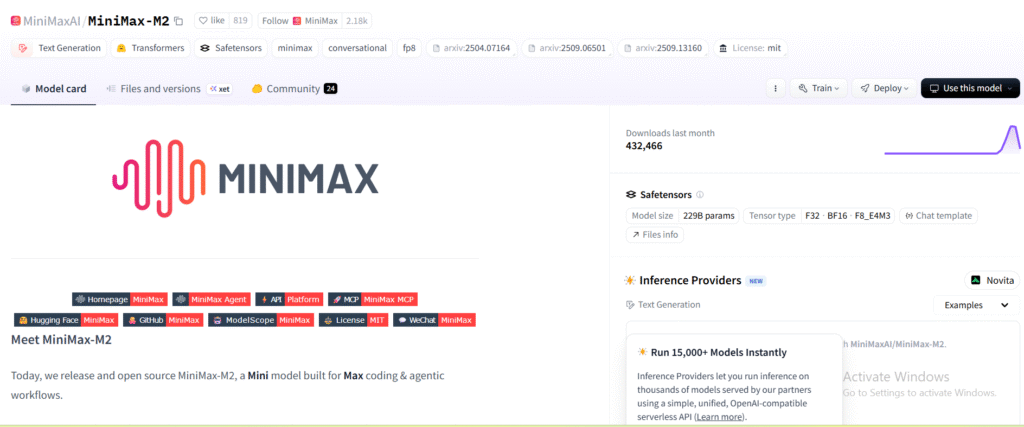
Step 1: Go to the Official Model Page
- Visit the official MiniMax-M2 page on Hugging Face:
https://huggingface.co/minimaxai/minimax-m2 - Click on the “Files and versions” tab.
- You’ll see multiple downloadable files such as:
config.jsontokenizer.modelpytorch_model.binormodel.safetensors
To directly download, click on each file and then select “Download” from the file view page.
Read Now: Sora 2 APK Mod Premium Unlocked ( 3.12.0): Latest Version Download & Its Feature
Step 2: One-Click Direct Download (Optional Shortcut)
If you just want to download the entire model without using Git, you can use this direct link shortcut:
Direct Download – MiniMax-M2 Model Folder
From there, click the “Download all files” button (top right).
This will start a ZIP download of the full model repository — easy and beginner-friendly.
Step 3: Install Git and Git LFS (For Developers)
If you prefer the command-line method (recommended for developers), install Git and Git-LFS:
Windows
git lfs install
git clone https://huggingface.co/minimaxai/minimax-m2
macOS or Linux
sudo apt install git git-lfs -y
git lfs install
git clone https://huggingface.co/minimaxai/minimax-m2
This will automatically download all the model files to your system.
Step 4: Download a Quantized (Lightweight) Version
If your PC or GPU is not powerful, use a smaller (quantized) version such as 8-bit or 4-bit.
To install via Python:
pip install transformers accelerate auto-gptqThen run:
from transformers import AutoModelForCausalLM, AutoTokenizer

model_name = "minimaxai/minimax-m2-8bit"
tokenizer = AutoTokenizer.from_pretrained(model_name)
model = AutoModelForCausalLM.from_pretrained(model_name)
Step 5: Test the Model
You can quickly test the model by running:
from transformers import pipeline

pipe = pipeline("text-generation", model="minimaxai/minimax-m2")
result = pipe("Write a short paragraph about agentic AI.", max_length=80)
print(result[0]['generated_text'])
If you see an output, your MiniMax-M2 is installed correctly.
Alternative: Use MiniMax API Without Download
If you don’t want to download large files, you can use MiniMax-M2 directly from the cloud:
- Go to https://www.minimax.io
- Create a free account
- Access the API section and generate your API key
- Use the model directly via HTTP requests or SDK
Comparison with Other Models
The MiniMax-M2 model competes with major large language models such as OpenAI’s GPT-4, Anthropic’s Claude 3, and Meta’s Llama 3.
While each model has its strengths, MiniMax-M2 stands out for its efficiency, scalability, and agentic capability.
| Feature | GPT-4 | Claude 3 | Llama 3 | MiniMax-M2 |
|---|---|---|---|---|
| Architecture | Dense Transformer | Dense Transformer | Sparse Transformer | Mixture-of-Experts (MoE) |
| Parameters | ~1T (estimated) | ~860B | 405B | 230B (10B active) |
| Efficiency | Moderate | High | High | Very High |
| Context Length | 128k | 200k | 128k | Long Context Supported |
| Agentic Abilities | Limited | Moderate | Low | Advanced |
| Cost | High | High | Free/Open | Free/Open Access |
Overall, MiniMax-M2 delivers performance comparable to GPT-4-tier models but at a fraction of the computational cost, making it attractive for open-source developers and startups looking for high performance on a limited budget.
Use Cases
MiniMax-M2’s design makes it suitable for a variety of real-world and research-oriented applications:
1. Coding Assistant for Developers
Developers can use MiniMax-M2 as a code-writing and debugging assistant, helping to generate efficient code, suggest improvements, or automate repetitive programming tasks.
2. AI Tool and Agent Building
The model’s agentic architecture allows it to interact with APIs, databases, and software tools — ideal for building autonomous AI agents and chat-based productivity systems.
3. Automation and Research Projects
MiniMax-M2 can automate data analysis, content generation, and workflow management.
It’s also valuable for academic and industrial research, especially in areas related to reasoning, NLP, and AI ethics.
Access & Availability
Official Website
You can explore official updates and API documentation at:
https://www.minimax.io
Free API Trial
MiniMax AI offers a limited free API trial, allowing developers to test the M2 model directly from their web dashboard.
Local Setup Options
MiniMax-M2 can be downloaded and run locally through Hugging Face, with full or quantized versions available for both high-end and moderate systems.
App Availability Status
Currently, MiniMax-M2 is not available as a mobile application.
There is no official app on the Google Play Store or Apple App Store — the model can only be accessed via web or local developer environments.
Limitations & Challenges
Despite its strengths, MiniMax-M2 has a few limitations worth noting:
1. Hardware Requirements
Running the full 230B-parameter model requires high-end GPUs with large VRAM (40–80 GB).
Although quantized versions are available, they still demand a capable setup for smooth performance.
2. Community Support
Compared to more established open models like Llama 3 or Mistral, MiniMax-M2’s community ecosystem is smaller, meaning fewer third-party tools, tutorials, and integrations are available.
3. Language Limitations
While the model performs well in English and Chinese, support for other languages (including Hindi and multilingual contexts) is still under development.
Accuracy and fluency may vary for regional languages.
What MiniMax-M2 Is Not (Clarification Section)
It’s important to clarify what MiniMax-M2 is not, as there are many unrelated apps and products using similar names online:
- It is not a mobile app — you will not find it on the Play Store or App Store.
- It is not an offline chat app that runs like ChatGPT without the internet.
- It is not related to any MiniMax video or song-making app — those belong to different projects.
- It is an AI model, designed primarily for developers, researchers, and AI engineers to integrate into their own tools and systems.
Conclusion
MiniMax-M2 represents a significant step forward in the evolution of open-source AI.
By combining Mixture-of-Experts efficiency, agentic reasoning, and developer accessibility, it offers a powerful alternative to closed models like GPT-4.
Its open-weight availability and free API trial lower the barrier to entry for developers and researchers, enabling them to explore advanced AI capabilities without heavy costs.
While the ecosystem is still growing, MiniMax-M2 has the potential to redefine how AI agents, automation systems, and next-generation tools are built in the years to come.

Sia is the co-founder of Corenexis and one of the earliest voices shaping its editorial direction. With years of hands-on experience covering AI and technology, she has been writing about the digital world long before it became everyone's favorite topic — and she still does it better than most.
View all posts by Sia →


2 Comments
Your point of view caught my eye and was very interesting. Thanks. I have a question for you.
Thanks for sharing. I read many of your blog posts, cool, your blog is very good.
Community guidelines
We want the comments to be useful for every reader. Every comment is reviewed before it is published. A comment will not be approved if it is:
Keep it genuine and on-topic and it will be approved quickly. Thank you for helping keep the discussion clean.