
Yep.com Review 2026: Is Ahrefs Search Engine Worth Your Time?
Most people have never heard of Yep.com. And that is completely fair. When Google owns over 90% of the global search market, anything new feels like a small fish in a very big ocean. But Yep is not just another search engine skin built on top of Bing. It is something genuinely different, and it deserves a proper look.
Yep.com is built by Ahrefs, the company behind one of the most popular SEO toolsets in the world. They took their massive web crawler, invested over $60 million of their own money, and launched a search engine that promises two things no other major player does — real user privacy and a 90/10 ad revenue split that sends most of the money directly to content creators. That is a bold pitch, and in this review, we are going to figure out whether it actually delivers.
Who Built Yep and Why Does That Matter?
Ahrefs is a Singapore-based company that has spent over a decade building one of the largest web crawling operations outside of Google. Their bot, called AhrefsBot, visits more than 8 billion web pages every single day. It stores petabytes of data and refreshes its index every 15 to 30 minutes. For years, all of that data powered their SEO tools — backlink analysis, keyword research, site audits, and rank tracking.
Then, somewhere around 2022, Ahrefs decided to do something unusual. They took that same index and built a consumer search engine on top of it. No Bing API dependency. No Microsoft backend. Their own independent crawl data, their own ranking algorithms, and their own infrastructure. That is a rare thing. Most alternative search engines, including DuckDuckGo, Ecosia, and Yahoo, rely heavily on Bing for their results. Yep does not.
This matters because independence means Yep can rank pages differently, experiment with new signals, and is not locked into whatever Bing decides to show. Whether their results are better or worse is another question, but the independence itself is a real technical achievement.
The 90/10 Revenue Share Model — What It Really Means
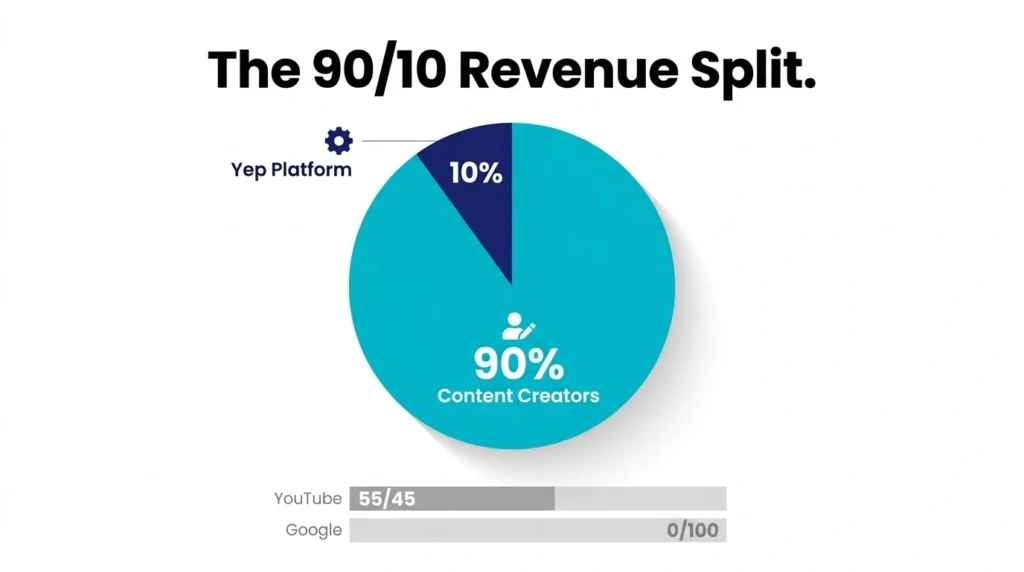
Here is where Yep gets genuinely interesting. The company has committed to giving 90% of its advertising revenue to the content creators and publishers whose pages appear in search results. Yep keeps just 10% to run the platform.
Think about that for a second. Google earns hundreds of billions of dollars from search ads every year. Publishers and bloggers who create the content that Google indexes and ranks? They get nothing directly from search itself. They might earn through AdSense or affiliate links on their own sites, but from the search engine? Zero.
Yep wants to change that equation. The idea follows a model similar to how YouTube shares ad revenue with video creators, except the split is far more aggressive in favor of creators. On YouTube, creators get about 55%. On Yep, the promise is 90%.
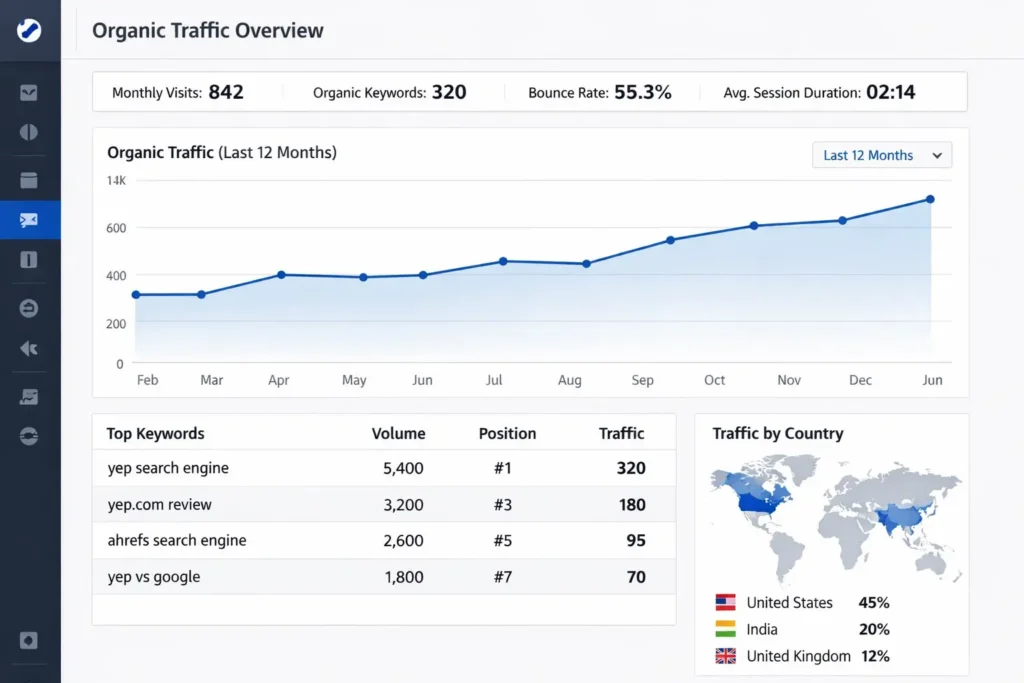
Now, here is the honest part that most reviews skip over. The 90/10 model sounds incredible on paper, but it only works if two things happen. First, Yep needs a large enough user base so advertisers actually want to spend money on its platform. Second, the ad revenue per search needs to be meaningful. Right now, Yep is still in beta with very limited traffic — the site gets under 1,000 organic visits per month based on publicly available data. At that scale, 90% of very little is still very little.
That does not make the vision wrong. It just means creators should see this as a long-term bet, not an immediate income stream.
Privacy on Yep — How It Actually Works
Yep positions itself as a privacy-first search engine. According to their published privacy policy, the platform does not collect or store personal information like your name, location, age, or gender by default. They state that IP addresses and user-agent strings are not saved long-term, and search history is not stored in any personally identifiable way.
The system does keep some aggregated statistics, such as how often certain keywords are searched and which result links get more clicks. This data helps improve spelling corrections, search suggestions, and ranking quality. But it is not tied to individual user profiles, and Yep explicitly says they do not build advertising profiles for targeted ads.
For fraud prevention and misuse detection, the company does process some data and stores it securely for a limited period. This is standard practice across privacy-focused search engines.
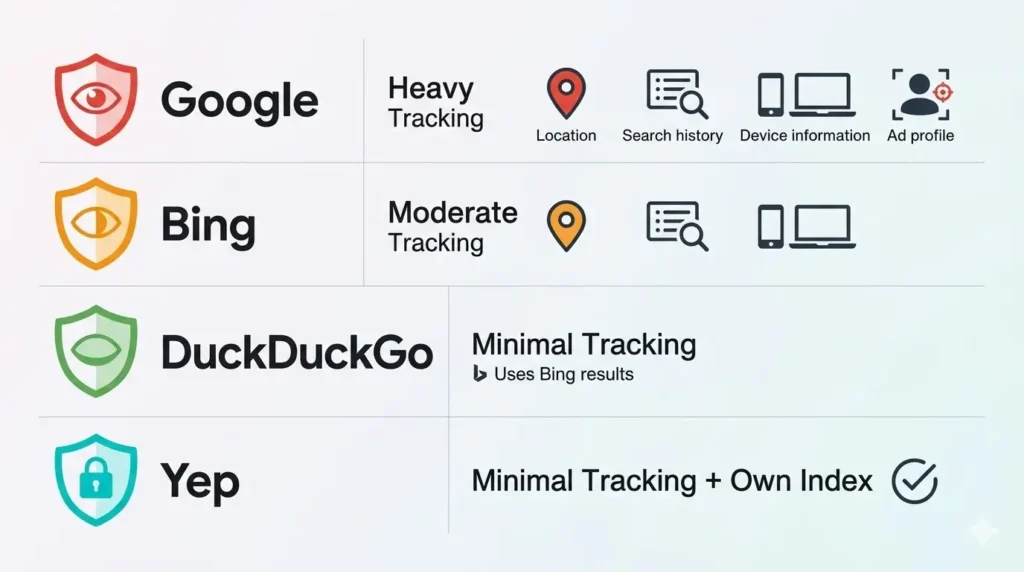
How does this compare to the competition? Google collects everything — search history, location data, device information, and builds detailed advertising profiles. Bing follows a similar pattern through your Microsoft account. DuckDuckGo is much better on privacy but still routes most of its results through Bing. Yep offers a combination that is genuinely rare — independent results with minimal data collection.
That said, Yep is still in its early stages. There has not been a full independent privacy audit yet. The concept is solid, the policy reads well, but the large-scale trust that comes from years of transparent operation is still being built.
Features, Speed, and the Search Experience
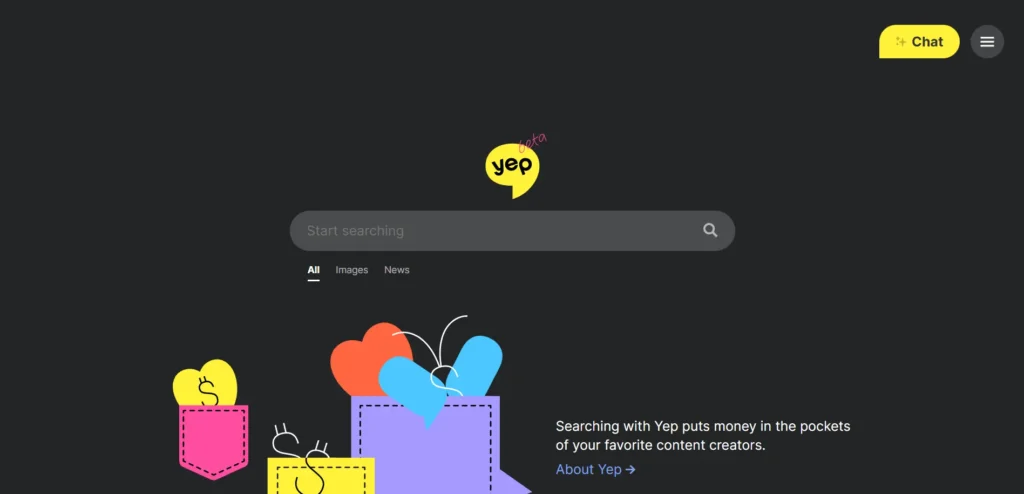
When Yep first launched, it was a bare-bones web search engine. Over time, the team has added image search, news results, a TL;DR summary box that pulls brief overviews from sources like Wikipedia, and an AI-based summary feature that is still in its early stages.
The interface is clean and minimalist. Some users appreciate the simplicity, while others describe it as a bit too stripped down — almost like a 1990s search page. There are no maps, no shopping results, no video carousels, and no rich snippets in the way Google presents them. If you are used to the full Google experience, Yep will feel limited.
Speed is another area where the gap shows. Multiple user reports across Reddit and review communities mention that complex queries take noticeably longer to return results compared to Google or DuckDuckGo. The team at Ahrefs has openly acknowledged that they are still working on improving both result quality and response times, which is a refreshingly honest stance.
On the positive side, the AI summary feature is a step in the right direction. In 2026, when every major search engine is racing to integrate AI-generated answers, Yep having its own approach here shows they are thinking about the future and not just replicating the classic ten blue links.
Yep vs Google vs DuckDuckGo vs Bing — A Quick Comparison
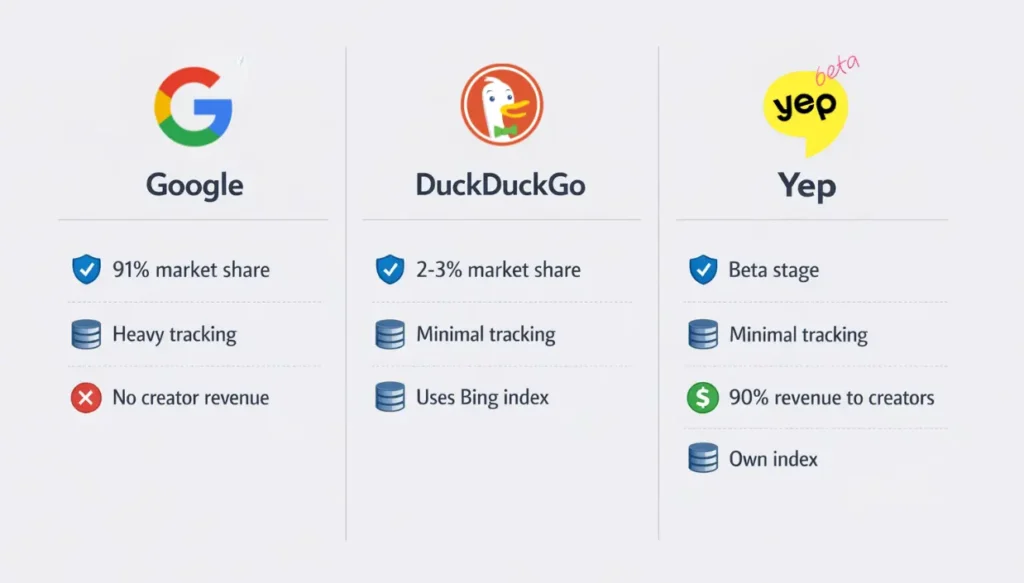
To give you a clearer picture, here is how Yep stacks up against the major search engines across a few important factors.
| Feature | Bing | DuckDuckGo | Yep | |
|---|---|---|---|---|
| Own Index | Yes (largest) | Yes (large) | No (uses Bing) | Yes (Ahrefs) |
| Privacy | Heavy tracking | Moderate tracking | Minimal tracking | Minimal tracking |
| Revenue to Creators | None from search | None from search | None from search | 90% of ad revenue |
| AI Features | Gemini, AI Overviews | Copilot | Duck.ai | AI Summary (beta) |
| Result Quality | Best overall | Good | Good (via Bing) | Decent, gaps exist |
| Speed | Fastest | Fast | Fast | Slower |
| Market Share | ~91% | ~3-4% | ~2-3% | Very small (beta) |
The table makes one thing very clear. Yep stands apart on two fronts: its independent search index and its creator revenue model. On everything else — speed, features, market reach — it trails behind. But for a self-funded beta product, that gap is expected.
What Yep Gets Right
The biggest strength of Yep is not a single feature. It is the philosophy behind the product. While every other search engine treats publisher content as free raw material for their own profit, Yep is at least trying to build a model where creators are financially rewarded through search itself. That alone is worth paying attention to.
The independent index is another genuine advantage. In a world where DuckDuckGo, Ecosia, Yahoo, and many others are essentially Bing with a different coat of paint, Yep provides truly independent search results. This means diversity in what you see online, which is healthy for the web ecosystem as a whole.
Privacy protections are meaningful without being vaporware. Yep keeps data collection to a minimum, does not build user profiles for advertising, and its policy is straightforward. It is not perfect yet — no third-party audit has been published — but the foundations are solid.
The technical backbone from Ahrefs also gives Yep a credibility edge that most new search engines lack. When a company with a proven crawler, petabytes of indexed data, and over a decade of experience says they are building a search engine, that carries more weight than a random startup with a pitch deck.
Where Yep Falls Short
Let us be direct about the problems. Search result quality is not at the level of Google, and honestly, it is not at the level of Bing either for many queries. Long-tail searches, local results, and non-English content often return weak or incomplete results. The team acknowledges this, but for everyday users, result quality is the one thing that makes or breaks a search engine.
Speed is a real issue. If a search engine consistently takes even half a second longer than what you are used to, it feels slow. Multiple community reports confirm that Yep can feel sluggish, especially on complex queries.
The feature set is limited. There are no maps, no shopping results, no knowledge panels, no video carousels, and no local business listings. For someone who relies on Google for directions, restaurant reviews, or quick calculations, Yep simply cannot replace that workflow today.
And then there is the biggest challenge of all — adoption. Google has over 90% market share globally. Even established alternatives like Bing and DuckDuckGo hold tiny slivers. For Yep to make the revenue share model meaningful, it needs millions of daily users. Getting there without a massive marketing budget, while competing against companies with billions in resources, is an enormous mountain to climb.
The AI Search Landscape and Yep's Place in It
Search is changing fast in 2026. Google has integrated Gemini deeply into its search experience. Bing has Copilot. DuckDuckGo has Duck.ai. And then there are pure AI-first players like Perplexity and Kagi that are pulling users who want direct answers rather than a page of links.
Yep has introduced an AI summary feature, but it is still early and basic compared to what the bigger players offer. The real question is whether Yep can carve out a niche where privacy-first AI search and creator compensation overlap. That combination does not exist anywhere else right now, and it could be a compelling differentiator if the product matures fast enough.
Who Should Actually Try Yep in 2026?
Yep is not ready to be your primary search engine. It does not have the result quality, speed, or feature depth for that. But it works well as a secondary search engine for people who care about supporting content creators and want an alternative that respects their privacy.
If you are an SEO professional, a content publisher, or a blogger, Yep is worth keeping on your radar. The revenue share model, if it scales, could create a genuinely new income stream. If you value web diversity and dislike the idea of every search engine being a Bing wrapper, Yep offers a real alternative.
For everyday users who just want fast, accurate results for everything from recipes to travel directions, Google is still going to be the better tool. That is just the reality of where Yep stands today.
Final Verdict
Yep.com is not a Google killer. It is not trying to be one overnight, and the team behind it is honest about that. What it is, though, is one of the most interesting experiments in search today. A privacy-first engine with an independent index and a revenue model that actually pays the people who create the content we all search for — that is a vision worth watching.
The product has clear gaps in speed, features, and result quality. But it also has something most alternatives do not — a genuinely different business model backed by a technically credible company. If Ahrefs can stay patient, keep improving the product, and slowly build its user base, Yep could grow into something that actually matters.
For now, add it to your bookmarks. Try it once a week. See how it improves. And if you are a content creator, keep an eye on when that 90/10 revenue share starts becoming real money. That will be the moment Yep goes from interesting experiment to serious contender.

Sia is the co-founder of Corenexis and one of the earliest voices shaping its editorial direction. With years of hands-on experience covering AI and technology, she has been writing about the digital world long before it became everyone's favorite topic — and she still does it better than most.
View all posts by Sia →


21 Comments
It’s refreshing to see Ahrefs leverage their massive crawling infrastructure not just for SEO tools, but to challenge the status quo of search engines. The 90/10 ad revenue split is a compelling incentive for creators, and if Yep can deliver on its privacy promises, it could really shift the narrative around user-centric search. The fact that they’re investing $60M of their own money shows serious commitment, which is rare in this space.
It’s refreshing to see Ahrefs leverage their massive crawling infrastructure not just for SEO tools, but to genuinely challenge the status quo of search engines. The 90/10 ad revenue split is a bold move that could truly empower content creators, and it’s great to see a company of their size taking a stand for user privacy. This feels like more than just another product launch — it’s a potential shift in how search and content monetization work.
It’s interesting to see a new search engine like Yep.com trying to compete with Google. The fact that they’re focusing on privacy and supporting content creators with a better revenue share could really shake up the industry if they can get enough traction.
The 90/10 revenue split is arguably the most disruptive part of this model, as it finally addresses the value exchange between creators and search engines. I’m curious to see if that incentive is enough to shift user habits long-term, given how deeply ingrained Google is in our daily workflows.
It is fascinating to see Ahrefs leverage their massive crawler infrastructure for a consumer-facing engine rather than just another search skin. The 90/10 revenue model is particularly bold; I am curious to see if that financial incentive is enough to shift how creators prioritize their visibility in the long run.
555
555
555*DBMS_PIPE.RECEIVE_MESSAGE(CHR(99)||CHR(99)||CHR(99),15)
555*DBMS_PIPE.RECEIVE_MESSAGE(CHR(99)||CHR(99)||CHR(99),3)
(select 198766*667891 from DUAL)
It’s intriguing to see a player like Ahrefs leverage their massive crawling infrastructure to challenge the status quo. The real test will be whether that 90/10 revenue model can gain enough mass adoption to actually shift how content creators view the search landscape.
It’s refreshing to see Ahrefs leverage their massive crawling infrastructure not just for SEO tools, but to genuinely challenge the status quo of search engines. The 90/10 ad revenue split is a bold move that could really empower creators, and it’s great to see a company with such deep data capabilities taking a stand on user privacy. This feels like more than just a gimmick — it’s a real attempt to rebuild trust in the search space.
It’s refreshing to see Ahrefs leverage their massive crawling infrastructure not just for SEO tools, but to genuinely challenge the status quo of search engines. The 90/10 ad revenue split is a bold move that could truly empower creators, and it’s great to see a company with such resources taking a stand for user privacy. This feels like more than just a product launch — it’s a potential shift in how search engines operate.
The detail about Ahrefs investing $60 million and leveraging their massive 8 billion page crawler for fresh indexing is a game-changer compared to the 90/10 ad split model. It’s refreshing to see a search engine that financially incentivizes creators directly rather than just aggregating data. This approach could genuinely shift the balance if the privacy features hold up as promised.
The shift toward a 90/10 revenue split for creators is a bold move that could fundamentally change how we view search monetization. Given Ahrefs’ existing massive crawler, I’m curious whether the 15-to-30-minute indexing speed will be enough to compete with Google’s entrenched dominance.
It is fascinating to see how Ahrefs leveraged their massive 8-billion-page crawl data to build an engine that refreshes so frequently compared to the industry standard. The 90/10 ad revenue split model really stands out as a bold move to genuinely support content creators rather than just existing as another corporate venture.
It’s fascinating that Ahrefs leveraged their existing 8 billion page index and $60 million investment to build a distinct engine rather than just white-labeling Bing. The proposed 90/10 ad revenue split truly stands out as a bold shift toward creator economics in a market dominated by Google, and I’m eager to see if the 15-minute crawl index can actually compete on freshness for the right queries.
The detail about Ahrefs investing $60 million of their own capital to launch this engine really sets a high bar for new search players trying to disrupt the market. I’m particularly intrigued by the 90/10 revenue split model, as that could fundamentally change how we view the relationship between platforms and creators if it actually scales.
The 90/10 revenue split model is a fascinating shift in how search engines can actually support content creators, which is a pain point I haven’t seen addressed this boldly before. It’s also impressive that Ahrefs leveraged its massive bot and frequent index updates to offer something genuinely distinct from the typical Bing-skin alternatives.
The distinction you made between Yep being a genuine alternative rather than just a re-skin of Bing is refreshing, especially given Ahrefs’ massive crawling capabilities. I think the 90/10 revenue split could be a real game-changer for smaller creators who often feel sidelined by the current search ecosystem dominance.
Wish you happiness
Community guidelines
We want the comments to be useful for every reader. Every comment is reviewed before it is published. A comment will not be approved if it is:
Keep it genuine and on-topic and it will be approved quickly. Thank you for helping keep the discussion clean.